

Law firms must implement prioritized technical controls, layered incident response, and firm-wide governance because protecting client data is an ethical duty, not an IT preference. The highest-impact moves are multi-factor authentication, endpoint detection and response, offline encrypted backups, a written incident response plan, vendor vetting, and recurring security training. ABA Model Rules 1.1 and 1.6 already require reasonable safeguards. What follows is the order to build them in.
TL;DR:
- Law firms should prioritize strong identity management, endpoint detection, and encrypted offline backups to quickly reduce breach risks from credential theft and ransomware.
- Immediate breach response must include system disconnection, forensic preservation, and notification under ethical and legal obligations, with a documented plan improving cost outcomes.
- Governance requires written policies, annual risk assessments, and clear metrics, with ongoing partner-level oversight to ensure security controls are effectively maintained.
- Zero trust principles mean restricting access to matter files via MFA, endpoint security, and precise permission reviews, with defined recovery objectives to mitigate ransomware damage.
- Regular staff training and secure centralized case management significantly lower human error and data sprawl, reducing exposure from phishing and email-based sharing.
Table of Contents
- What Are the Highest-Priority Law Firm Data Security Controls?
- What Should a Law Firm Do Immediately After a Data Breach?
- How Should Firm Leadership Govern Data Security Policy?
- Which Technical Controls Actually Belong in a Zero Trust Setup?
- How Do You Manage Vendor and Third-Party Risk?
- How Often Should Law Firms Train Staff on Cybersecurity?
- Why Centralized Case Management Reduces Data Exposure
- Author Perspective: How to Prioritize Security Spending by Firm Size
- A Different Way to Cut Document-Sharing Risk
- Sources
- FAQ
What Are the Highest-Priority Law Firm Data Security Controls?
Client files, medical records, and settlement details make law firms a favorite target for ransomware crews and business email compromise scams. Fixing everything at once is impossible, so sequence matters more than ambition.
Here's the order that actually reduces risk fastest, based on where breaches originate:
- Identity and access management. Turn on MFA everywhere, enforce least-privilege permissions, and issue hardware security keys to anyone who touches trust accounts or wire transfers. Credential theft and business email compromise remain the top breach vectors for law firms, which is exactly why this sits at the top of the list rather than further down.
- Endpoint detection and response (EDR). Antivirus alone catches yesterday's threats. EDR watches behavior in real time and patches need to roll out on a strict cadence, not whenever IT gets around to it.
- Immutable, encrypted backups. Store them offline or in an isolated cloud tier that ransomware can't reach, and actually restore from them periodically to confirm they work.
- Secure email and client portals. Configure DMARC, DKIM, and SPF to stop spoofed firm emails, and encrypt anything containing personally identifiable information.
- Logging and monitoring. You cannot investigate what you never recorded. Centralized logs cut triage time from days to hours.
Solo and small firms with tight budgets should start with a password manager, MFA on email and case management logins, and a $10 to $20 per user EDR tool before spending anything on consultants.
Pro Tip: If you can only fund one control this quarter, fund MFA on email. It blocks the majority of the phishing and account-takeover attempts that lead to six-figure wire fraud losses.
What Should a Law Firm Do Immediately After a Data Breach?
Contain first, investigate second. Disconnect affected systems from the network without powering them off, preserve logs and memory states for forensics, and resist the urge to "clean up" anything before your incident response team has imaged the affected machines.
NYC Bar Formal Opinion 2024-3 makes clear that firms have an ethical duty to take immediate proactive steps and notify clients under Rule 1.4 once their interests are affected, alongside whatever state breach notification statute applies. ABA Formal Opinion 483 reinforces the same obligation at the national level.
Your checklist for the first 24 hours:
- Activate the incident response plan and call breach counsel before your cyber insurer, so privileged communications stay protected from the start.
- Notify your cyber insurer within the policy's reporting window. Late notice can jeopardize coverage.
- Document every action taken, with timestamps, for later regulatory and insurance review.
- Assess double-extortion risk. If attackers threaten to publish stolen files, privileged communications across multiple matters could be exposed.
Organizations with a documented incident response plan cut breach costs substantially compared to those improvising in the moment, according to Microsoft's Digital Defense Report. A plan drafted during a calm Tuesday afternoon works far better than one written during a live ransomware event.
How Should Firm Leadership Govern Data Security Policy?
Technical controls fail without governance behind them. Partners need to own this, not delegate it entirely and forget about it.
- Adopt a written information security policy with a named owner, whether that's a managing partner, a CIO, or an outsourced security lead.
- Run an annual risk assessment and asset inventory. You cannot protect data you don't know exists on which servers.
- Write an AI acceptable-use policy. Shadow AI use, staff pasting client facts into a public chatbot, risks waiving privilege without anyone noticing.
- Set cyber insurance requirements and a reporting cadence. Underwriters increasingly require proof of MFA, EDR, and a written incident response plan before issuing or renewing a policy.
Pro Tip: Put security metrics on the partner meeting agenda quarterly, not annually. A once-a-year review means twelve months can pass before anyone notices a policy gap.
Which Technical Controls Actually Belong in a Zero Trust Setup?
Zero trust for a law firm means nobody, not even a founding partner, gets standing access to every matter file by default. Access follows the matter, not the org chart.
Here's what that looks like in practice:
- MFA with hardware tokens for anyone with trust-account or wire authority, not just a text-message code.
- EDR deployed on every endpoint, including partner laptops and paralegal desktops.
- DMARC set to enforcement (not just monitoring mode), plus encrypted email consistent with ABA Formal Opinion 477R.
- Immutable, offline backups tested quarterly against a defined recovery time objective and recovery point objective.
- Patch management with a 14-day maximum window for critical vulnerabilities.
| Control | Target cadence | Owner |
|---|---|---|
| MFA audit | Quarterly | IT/security lead |
| Backup restore test | Quarterly | IT/security lead |
| Critical patch deployment | Within 14 days | IT/managed provider |
| Access review by matter | Semiannual | Practice group leads |
| Full risk assessment | Annual | Managing partner/CIO |
Recovery time objective and recovery point objective sound abstract until a ransomware group locks your document server on a Friday afternoon before a Monday filing deadline. Define both numbers now, in hours, not "as soon as possible."
How Do You Manage Vendor and Third-Party Risk?
Every cloud vendor, e-discovery platform, and process server integration is a door into your firm's data. Most firms never inventory these doors, let alone lock them.
- Build a vendor inventory and tier each one by the sensitivity of data it touches.
- Require SOC 2 Type II or an equivalent audit report from any high-risk vendor handling client files or PII.
- Send a security questionnaire before signing, and reserve audit rights for the contract term.
- Negotiate breach notification timeframes, indemnification language, and a requirement that the vendor carry its own cyber insurance.
- For vendors that can't meet your bar, segment their access and limit what data they can reach rather than walking away entirely.
A single unvetted e-filing integration or copy service can expose more client data than a phishing email ever could.
How Often Should Law Firms Train Staff on Cybersecurity?
Annual training alone isn't enough. Attackers refine phishing lures faster than a once-a-year session can cover.
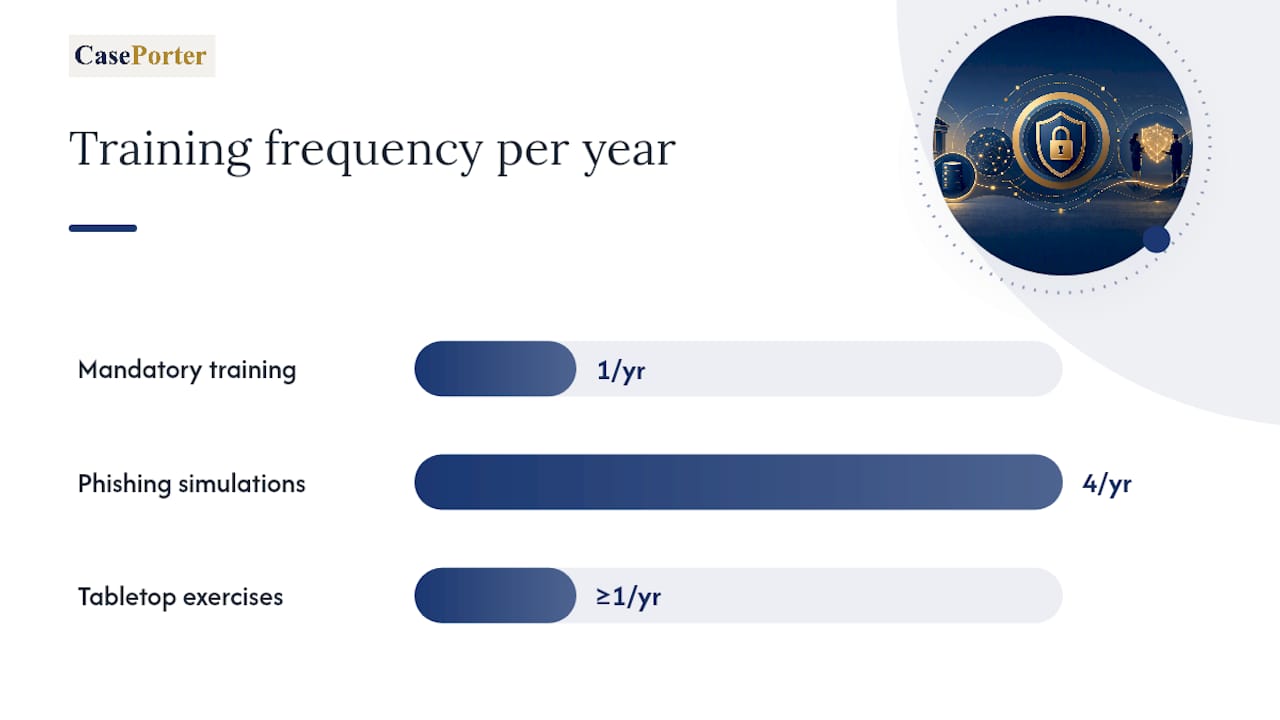
- Run mandatory annual training for every employee, from partners to reception staff.
- Layer in quarterly simulated phishing campaigns to keep awareness sharp between sessions.
- Hold tabletop incident response exercises at least once a year with a cross-functional team, including outside counsel and forensics on standby.
- Track click rate, time to detect, and time to contain as your core metrics, and report them to partners.
- Apply real consequences for repeated noncompliance, not just a reminder email.
Relying on antivirus alone leaves the human layer exposed; phishing simulations and tabletop drills catch what software can't.
Pro Tip: Reward the employee who reports a phishing simulation fastest, don't just penalize the ones who click. Positive reinforcement gets more people paying attention.
Why Centralized Case Management Reduces Data Exposure
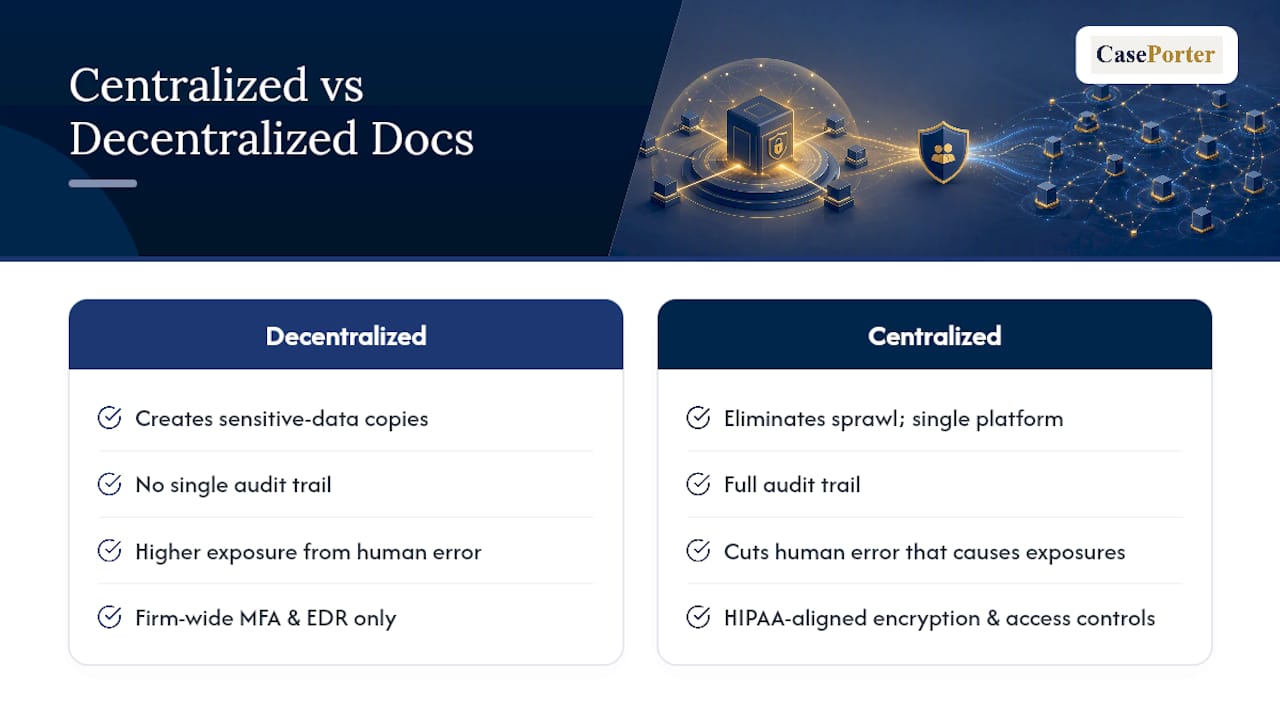
Every email attachment, shared drive link, and forwarded PDF is a copy of sensitive data living somewhere new. Centralizing documents inside one platform with a full audit trail eliminates that sprawl and cuts the human error that causes most exposure incidents.
HIPAA-aligned encryption and access controls inside a case management system function as an additional layer on top of firm-wide MFA and EDR, not a substitute for them. For firms deciding whether to adopt a platform, the real question isn't the tech stack. It's whether staff will stop emailing medical records as attachments once a secure alternative exists.
Author Perspective: How to Prioritize Security Spending by Firm Size
Solo and small firms get more from MFA and a $15 per user EDR tool than from a $50,000 penetration test they can't act on. Midsize firms should weigh an MSSP against hiring in-house. An MSSP wins on cost predictability; in-house wins on institutional knowledge of your matters. Whatever you choose, report metrics to partners in dollars avoided, not just incidents blocked. That's the number that keeps budget approved next year.
— Yoseph
A Different Way to Cut Document-Sharing Risk
Every control on this checklist protects data you still have to move between people, and most firms move it by email attachment, which is exactly the habit creating exposure. There are case management platforms with secure document handling and HIPAA compliance designed into the workflow rather than bolted on afterward.

Instead of paralegals emailing medical records back and forth or juggling versions across shared drives, some case management platforms centralize intake, document handling, and matter tracking with a single audit trail. That's fewer email exchanges carrying protected health information and one place to prove who accessed what, and when, if a regulator or insurer ever asks. If your firm is evaluating where secure case management fits into its broader security posture, start with a CasePorter demo and walk through a security review with your own IT policy in hand.
Sources
- Formal Opinion 2024-3: Ethical obligations relating to a cybersecurity incident | NYC Bar
- Microsoft Digital Defense Report 2022: State of cybercrime | Microsoft
FAQ
What Is the 80/20 Rule for Lawyers in Data Security?
Applied to security, the 80/20 rule means roughly 20% of controls, MFA, EDR, and backups chief among them, prevent about 80% of the incidents law firms actually face. Spend there first before chasing more exotic protections.
Should I Hire an Attorney After a Data Privacy Breach?
Yes. Breach counsel helps preserve attorney-client privilege during the investigation, guides state notification compliance, and coordinates with your cyber insurer, which is exactly why Formal Opinion 2024-3 recommends looping counsel in before the insurer.
Do Lawyers Really Make $500,000 a Year?
Some do, typically equity partners at large firms or successful practice owners, but that figure sits far above the median attorney salary and has no bearing on how much a firm should budget for security.
How Accurate Is the Show Suits at Depicting Law Firm Security?
Not accurate at all. Real firms can't leave client files on unlocked desks or send privileged documents over unsecured channels the way the show portrays; ethical rules and encryption requirements exist precisely to prevent that.
What's the Difference Between Cyber Insurance and Professional Liability Coverage?
Cyber insurance covers breach response costs, notification, and ransomware, while professional liability covers claims of legal malpractice. Firms need both, and insurers increasingly require MFA and EDR before issuing either.