

Yes: paired with attorney verification, AI can produce a litigation-ready first draft of a demand letter much faster than manual drafting, which normally takes hours. The catch is that "litigation-ready" only happens after a lawyer checks the facts, the citations, and the damages math. Before you prompt anything, gather the chronology, medical records, bills, and your target settlement number. Skip verification and you risk sending a confident-sounding letter built on a fact the AI invented.
TL;DR:
- AI-generated demand letters require detailed, structured source documents to minimize factual inaccuracies and hallucinations, including medical records, bills, and incident reports.
- An attorney must verify every fact, citation, and damages figure against source documents before sending, as AI drafts are prone to unsupported claims and incorrect legal references.
- Firms should adopt a five-stage workflow: collect documents, structure prompts, generate draft, review thoroughly, and finalize with proper documentation to ensure compliance and accuracy.
- Linking each sentence to a verified source and maintaining an audit trail is essential for legal defensibility and to prevent errors from reaching the opposing party.
- Using a specialized AI platform that integrates with case management and preserves source links simplifies review, enhances accuracy, and supports scaling demand letter creation.
Table of Contents
- How Does an AI Demand Letter Actually Get Built?
- Step-By-Step Workflow For AI Demand Letters
- Prompt Templates You Can Paste And Adapt
- Staying Compliant: Ethics, HIPAA, and Recordkeeping
- How Firms Actually Run AI Demand Letters Day To Day
- What I've Learned Watching Firms Adopt This Technology
- See How CasePorter Handles Demand Letter Drafting
- Primary Sources Worth Bookmarking
- Sources
- FAQ
How Does an AI Demand Letter Actually Get Built?
Feed an AI tool the right inputs and it will assemble a coherent draft fast. Feed it thin or messy inputs and it will fill the gaps with something that sounds plausible but isn't true. That's the entire risk profile in one sentence.
The tool needs a case chronology, the police or incident report, medical records and billing summaries, wage-loss documentation, insurance policy limits, and any prior correspondence with the adjuster. The more structured the input, the less the model has to guess.
A well-built draft typically includes six components: a header identifying the parties and claim number, a facts narrative describing the incident and injuries, a legal theory statement (negligence, premises liability, whatever fits), an itemized damages section, a settlement demand anchor, and a response deadline with a signature block. Most AI tools produce all six on a first pass. What they don't reliably produce is accuracy on the details that matter most.
Watch for these failure modes before a letter ever leaves the office:
- Unsupported factual claims. The model states an injury detail, treatment date, or dollar figure that doesn't actually appear in the source documents.
- Hallucinated citations. Case law or statutory references that sound real but don't exist, or exist but say something different. Research on demand-letter AI from Stanford's Justice Innovation program flags this as one of the more persistent risks in automated legal drafting.
- Jurisdiction mismatch. A comparative-negligence state gets contributory-negligence language, or a statute of limitations reference doesn't match the filing state.
- Tone errors. Either too aggressive for an early-stage claim or too soft for a case with strong liability facts.
These aren't rare glitches. They're a predictable consequence of how large language models work: they generate the statistically likely next word, not a verified fact. Natural language processing research explains why models are prone to this kind of confident error, sometimes called hallucination, especially when the prompt lacks grounding documents.
The fix isn't avoiding AI. It's building verification into the process. Every factual assertion in the draft needs a matching source document. Every citation needs a human check against a current legal database. Every damages figure needs to tie back to an invoice or wage record, not an AI estimate.

Step-By-Step Workflow For AI Demand Letters
Treat AI demand letter drafting as a five-stage pipeline, not a one-click task. Firms that skip stages are the ones that end up correcting embarrassing errors after a letter is already in an adjuster's inbox.
- Intake and document collection. Before anything touches an AI tool, compile the medical records, itemized bills, wage-loss letters, photos, the incident report, any signed medical releases, and a plain chronology of events from injury to present treatment status.
- Structure the prompt or document feed. Upload the source documents directly if your tool supports it, rather than typing a summary. Specify the desired tone (firm but professional works for most first demands), the settlement anchor, and any jurisdiction-specific language the letter needs.
- Generate the draft. Let the AI produce a full first pass, including the facts narrative, legal theory, damages table, and closing demand.
- Attorney review. This is the checkpoint that makes the letter defensible. Confirm every fact against source records, verify every citation, check that exhibits are properly referenced, and confirm no privileged or unnecessarily broad health information made it into the letter.
- Finalize and send. Package the letter with numbered exhibits, format it to firm letterhead standards, log to send date and method, and set a calendar reminder for the response deadline you stated in the letter.
Pro Tip: Build a standing review checklist your paralegals run before any AI draft reaches an attorney's desk. Catching a wrong policy limit or mismatched date at the paralegal stage saves partner time and catches errors earlier.
The attorney review checklist deserves its own attention, because it's the step most firms shortcut when they're busy. At minimum, confirm: every dollar figure matches a bill or wage document, every date matches the medical record or police report, every citation is current law in the right jurisdiction, no client health information exceeds what's necessary for the claim, and the tone matches your actual negotiation strategy for that case.
If the letter gets no response or a lowball counter, that's not a drafting failure. It's the ordinary rhythm of pre-litigation negotiation, and your next move (a follow-up letter, a suit filing, or a phone call to the adjuster) should already be part of the case plan before the first letter goes out.
Prompt Templates You Can Paste And Adapt
A good prompt for an AI-generated letter needs four ingredients: the facts (fed as documents, not summarized from memory), the evidence you want cited, the tone you're targeting, and your settlement anchor. Loose prompts produce loose drafts.
Template 1, document-fed and litigation-ready: "Using the attached medical records, incident report, and billing summary, draft a demand letter for a [type of claim] under [state] law. Include a facts narrative, a negligence theory citing the attached police report, an itemized damages section totaling the attached bills plus [wage loss amount], and a settlement demand of [$X]. Set a response deadline of [30] days. Do not cite case law unless it appears in the attached materials."
Template 2, minimal intake quick-draft: "Draft a preliminary demand letter outline for a [claim type] involving [brief fact pattern]. Flag every section where a specific date, dollar amount, or citation is needed so I can supply it before finalizing."
The second template is useful for early triage on a high-volume caseload, where you want structure before you've pulled every record.
For the snippet bank, a few frames come up in almost every letter:
- Opening line: "This letter serves as formal notice of a claim arising from the [date] incident at [location], in which our client, [name], sustained injuries due to [party]'s negligence."
- Statement-of-facts starter: "On [date], [client] was [action] when [defendant] [negligent act], resulting in [immediate injury]."
- Legal-basis frame: "Under [state]'s negligence standard, a party who breaches a duty of care owed to another and causes resulting harm is liable for damages proximately caused by that breach."
- Damages table header: list medical specials, lost wages, and pain-and-suffering multiplier or narrative separately, never blended into one number.
- Deadline language: "Please respond with a settlement offer within [30] days of the date of this letter, after which we will proceed with litigation."
Customize the anchor number based on your case valuation model, not the AI's suggestion. Lock every citation to a current legal database before the letter leaves the office, and adjust tone up or down depending on whether this is a first demand or a post-litigation follow-up.
Staying Compliant: Ethics, HIPAA, and Recordkeeping
The ABA's Model Rules of Professional Conduct don't have a rule labeled "AI," but three existing rules govern how you use it anyway: competence, supervision, and candor. Competence means you understand the tool's limitations well enough to catch its mistakes. Supervision means an AI draft gets treated the way you'd treat a first-year associate's draft, reviewed line by line, not skimmed. Candor means nothing goes to an adjuster or opposing counsel that you haven't verified as true.
Medical records raise a second layer of risk. Uploading protected health information to a third-party AI tool without checking that vendor's data-handling practices can create exposure well beyond a drafting error.
Practical mitigations that work in daily practice:
- Confirm any AI vendor's data retention and encryption practices before uploading client medical records.
- Limit uploads to the minimum health information necessary for that specific letter.
- Keep local, firm-controlled copies of every source document referenced in the draft.
- Log who generated the draft, who reviewed it, and what changes were made, creating an audit trail that shows attorney oversight.
- Use firm-approved prompt language rather than ad hoc phrasing from individual staff.
That audit trail matters more than most firms realize. If a letter's accuracy is ever challenged, being able to show exactly which document supported which sentence, and which attorney signed off, is the difference between a quick explanation and a real problem.
How Firms Actually Run AI Demand Letters Day To Day
Firms that get real value from this technology don't ask AI to write a demand letter from scratch. They feed it structured case files and ask it to draft against those files, sentence by sentence, so every claim in the letter traces back to a document a human already reviewed.
That's the model a specialized AI platform might build around. Such a platform can ingest medical records and case documents, extract relevant facts, and generate draft language tied to specific source files rather than free-floating text. Attorneys would review the draft against an audit trail showing which record supported which sentence, reducing guesswork in verification and providing a documented record of oversight if a claim's accuracy is questioned.
The defensibility of an AI-assisted demand letter usually comes down to one operational habit: linking every sentence in the draft to a named source document and preserving an unbroken record of who reviewed and changed what. Firms that build this habit into their workflow catch errors before they leave the building, not after.
For a firm evaluating whether a platform like this fits its stack, the practical questions are straightforward: does it integrate with your existing case management system, does it handle the document volume your caseload generates, and does it give reviewing attorneys a clear, auditable view of what changed between the AI draft and the final letter.
What I've Learned Watching Firms Adopt This Technology
Firms that succeed with AI demand letters start small. They pick routine, low-injury-value letters first, measure how often the attorney has to correct factual errors, and only expand to complex cases once that error rate is low and predictable.
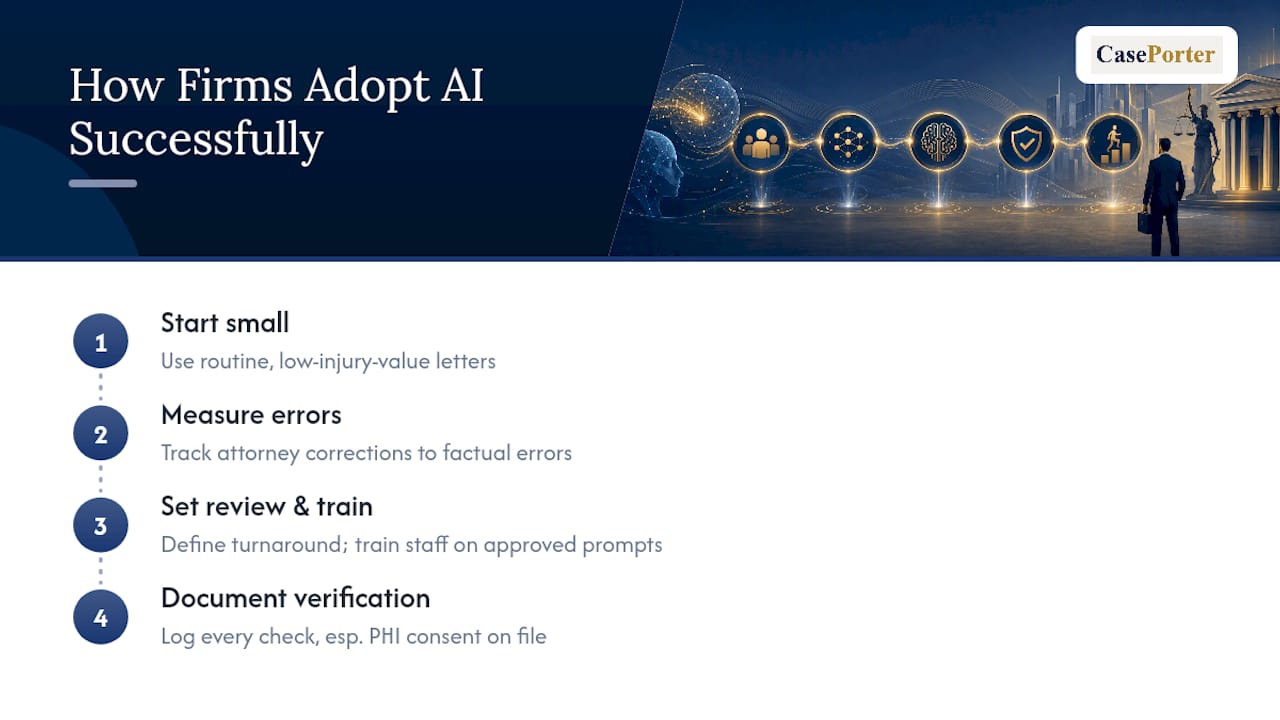
The firms that struggle usually skip the second part: defining a review turnaround time and training staff on approved prompt language. Without both, you get inconsistent drafts and an attorney who spends more time fixing letters than writing them would have taken in the first place.
One habit separates the firms that scale this well from the ones that don't: documenting every verification step, especially when a letter touches protected health information and needs client consent on file. That paper trail is what protects you if a letter's accuracy is ever questioned later.
— Yoseph
See How CasePorter Handles Demand Letter Drafting
If you're weighing whether to build this workflow with a general-purpose AI tool or a platform built specifically for personal injury practice, the gap shows up fastest in document handling. Some platforms ingest medical records and case files, keep them in compliant storage, and generate demand letter drafts tied directly to those source documents instead of relying on a loose prompt.
That means less time spent hunting for which bill supports which damages line, and an audit trail already built for the review step your Model Rules obligations require. Evaluating fit is simple: check how it connects with your current case management setup, how it handles your document volume, and what a migration from your existing process actually looks like. If you're ready to see the workflow on a real case file, request a demo at CasePorter and walk through a sample draft before you commit to anything.
Primary Sources Worth Bookmarking
For deeper reading on the topics covered here: Stanford's Justice Innovation program on demand-letter AI covers capability and risk research, the ABA Model Rules of Professional Conduct set the ethical baseline for supervision, and the Wikipedia entry on natural language processing explains the technical basis for hallucination risk.
This article is general information, not a substitute for advice from a qualified lawyer. Consult a qualified legal professional about your own circumstances before acting on anything here.
Sources
FAQ
Is a demand letter serious?
Yes. A demand letter is a formal legal notice that puts the recipient on record as aware of the claim, and it often sets the timeline for settlement negotiations or the next step toward litigation.
Can I write my own legal demand letter?
You can, but an unrepresented claimant's letter typically carries less negotiating weight than one from an attorney, and it risks factual or legal errors that damage the claim later. Attorneys using AI to draft their letters still need to verify every fact and citation before sending.
How long after a demand letter can I expect settlement?
Most demand letters set a response deadline of 30 days, but actual settlement timing varies widely by case complexity and insurer responsiveness. Some claims resolve within weeks; others take months of back-and-forth after the initial demand.
What should you avoid saying in a demand letter?
Avoid overstating injuries, citing unverified case law, disclosing more medical information than the claim requires, or setting an unrealistic deadline you're not prepared to enforce. Every factual and legal claim in the letter should trace back to a document you can produce if challenged.